The difference between process documentation and process performance

Most teams document steps. High-performing organizations engineer flow: clear outputs, explicit ownership, embedded measures, and a system that improves itself.

Why Process Excellence Often Fails

Good people burn out inside broken processes.

Process work fails when it's treated as documentation. It succeeds when it's treated as an engineered system with ownership, constraints, and measures.

1) The output is unclear

Teams map activity, not the result the process must reliably produce

2) Ownership is implicit

Accountability is assumed instead of designed (RACI is absent or performative)

3) Constraints are ignored

Bottlenecks, handoffs, and exceptions aren't engineered into the flow

4) Measures arrive late

KPIs are bolted on after the fact, so the process can't be managed

5) "One-and-done" design

No feedback loop, so the process decays the moment reality changes

Synerquest Reverse-Engineered Process Design™ prevents these failure modes by building from outputs backward—with measures embedded from day one.

Synerquest Reverse-Engineered Process Design™

We don't document processes — we engineer execution.

We start with the required output and engineer the process backwards—so ownership, controls, and measures are built in from the beginning.

1) Define the output

What "done right" must produce (quality, timing, risk)

2) Engineer backwards

Map the minimum sequence that reliably creates the output

3) Build the 80% with the owner

Iterate fast with key actors until the flow is workable

4) Validate with the network

Stakeholders walk the 80% process, surface exceptions, align handoffs

5) Lock it and operationalize

Sign-off, measures, RACI, tools/templates, and implementation support

Where this works best

  • Cross-functional processes with frequent handoffs (and "nobody owns the whole flow")
  • Teams scaling fast where tribal knowledge is turning into operational risk
  • ERP / platform changes that require process clarity before configuration (SAP, Oracle, Workday, ServiceNow)
  • Functions with high exception rates (approvals, procurement, finance ops, service delivery)
  • Environments where leadership needs measurable performance, not binders of maps

What you get in 30 days

  • A validated current-state baseline
  • A target-state process blueprint (L0–L3/L5 as needed)
  • Clear ownership and decision rights (RACI-aligned)
  • Embedded measures and control points
  • A prioritized execution roadmap

How Execution Is Engineered
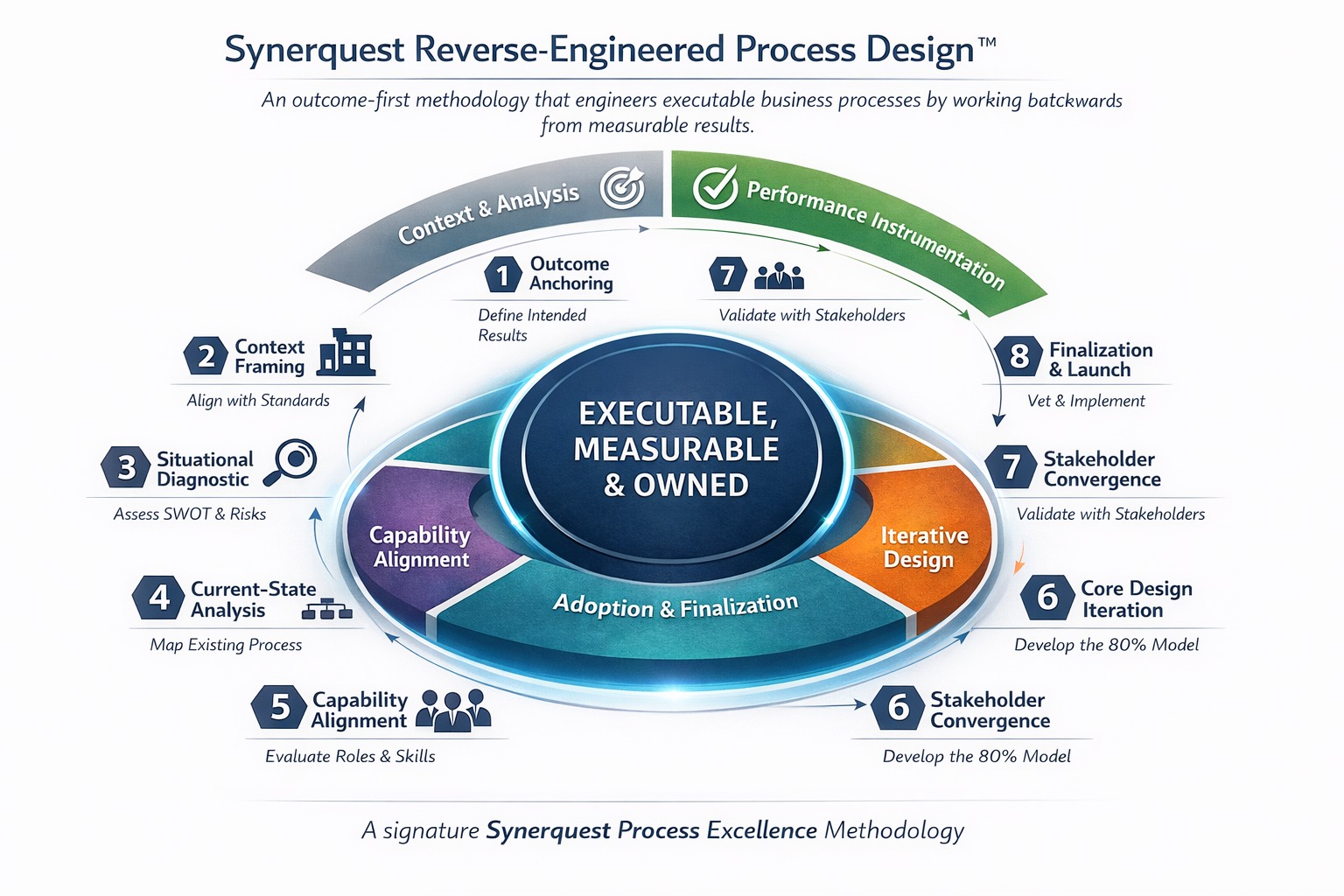
Synerquest Reverse-Engineered Process Design Methodology

Engineered from outcomes to execution.

How We Develop Executable Processes

Outcome Anchoring

Define outputs and success criteria.

Measurement Design

Embed performance measures and decision visibility.

Core Design Iteration

Build the 80% with process owners.

Stakeholder Convergence

Final walkthrough, feedback, and sign-off.

Designed for Measurement and Adoption

  • Measures embedded into process steps and ownership
  • Root cause analysis and problem framing where optimization is required
  • Capability assessment of actors, roles, and accountabilities
  • Enablement tools designed with the process (checklists, templates, SOP assets)
  • Continuous stakeholder alignment to eliminate surprises during implementation

Where This Works Best

  • ERP and enterprise platform transformations (SAP / Oracle / Dynamics environments)
  • Regulated and high-reliability operations (governance + auditability required)
  • Shared services and cross-functional handoff-heavy processes
  • Post-merger integration and operating rhythm stabilization

Enterprise Fit

  • Built to align with ERP execution (SAP S/4HANA, Oracle, NetSuite, Dynamics 365)
  • Process-to-platform mapping across EAM/HCM (Maximo, Workday, Ariba)
  • Modeling rigor (BPMN 2.0, SIPOC, Swimlanes, L0–L5 hierarchies)
  • Governance and accountability embedded (RACI, controls, decision rights)
  • Operational tooling integration (ServiceNow, Jira, Confluence, SharePoint)

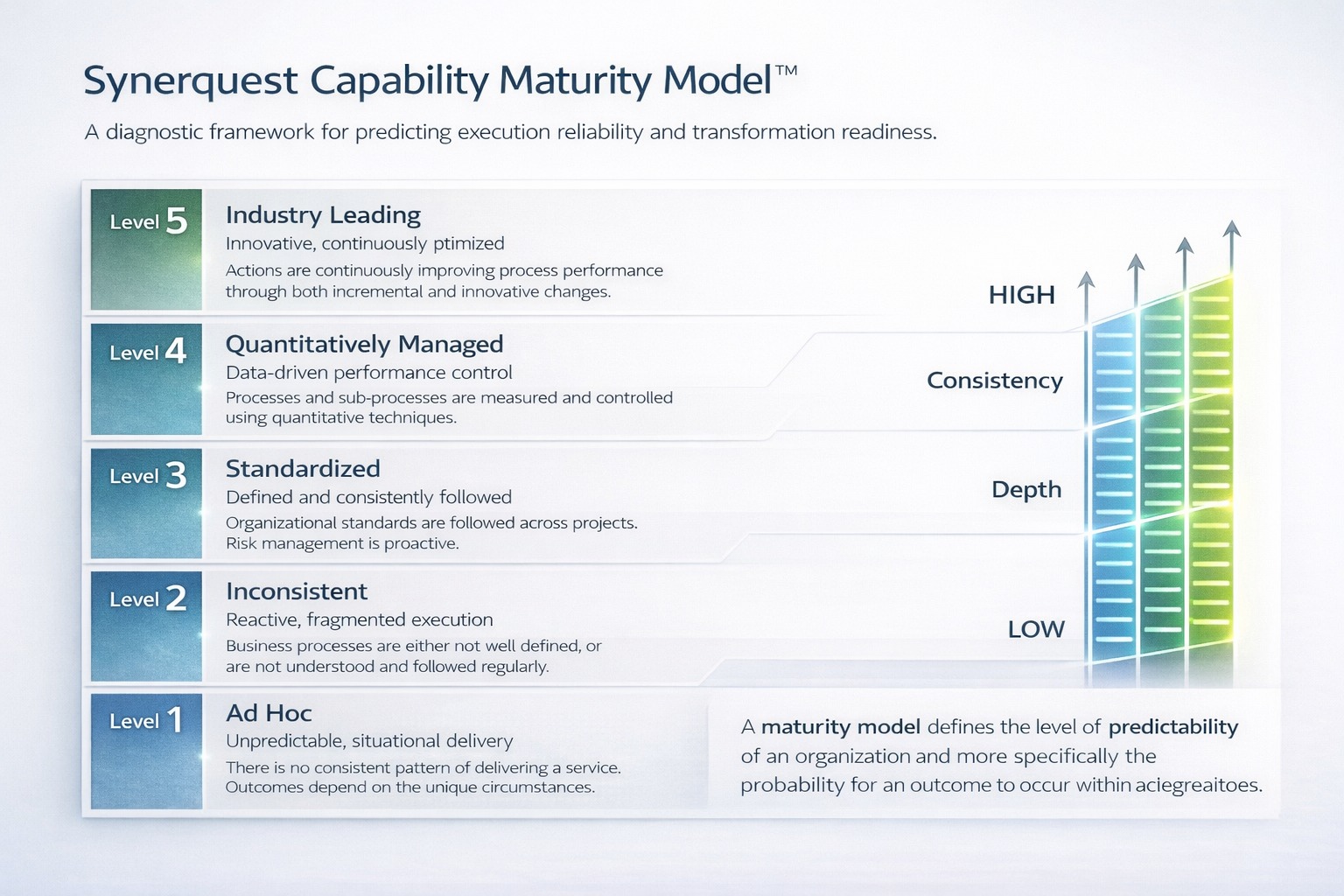
Capabilities Maturity Model

A practical, measurable view of what it takes to run processes that scale. We baseline current performance and capability, define target maturity, surface constraints, embed measures, and build a roadmap that translates improvement into execution.
What's Included

  • Current-state baseline — capability and performance snapshot using structured assessment + evidence
  • Target maturity definition — clear end-state levels aligned to business outcomes and process risk
  • Constraints + gap analysis — what's blocking maturity uplift, where capability shortfalls sit, and what to fix first
  • Embedded measures — KPIs and leading indicators tied to each maturity level (measurable by design)
  • Execution roadmap inputs — prioritized initiatives, sequencing, and enablement actions to reach target maturity
Synerquest Capability Maturity Model - 5 levels from Ad Hoc to Industry Leading

Ready to engineer process performance?

If you have a process that's documented but not predictable, we can help you make it measurable, executable, and owned.

Bring a real process. Leave with a practical path to measurable improvement.

Start the Conversation

What You Receive

  • Detailed Business Process Documentation Package
  • Multi-level swimlane diagrams (end-to-end + sub-process levels)
  • Numbered process steps aligned to roles and ownership
  • RACI tables aligned to process steps
  • Measurement points embedded into the process design
  • Enablement tools (templates, checklists, controls as applicable)
  • Final sign-off and implementation-ready handoff

Process Engineering Ecosystem

Process excellence lives at the intersection of methods, standards, improvement disciplines, and enterprise systems.
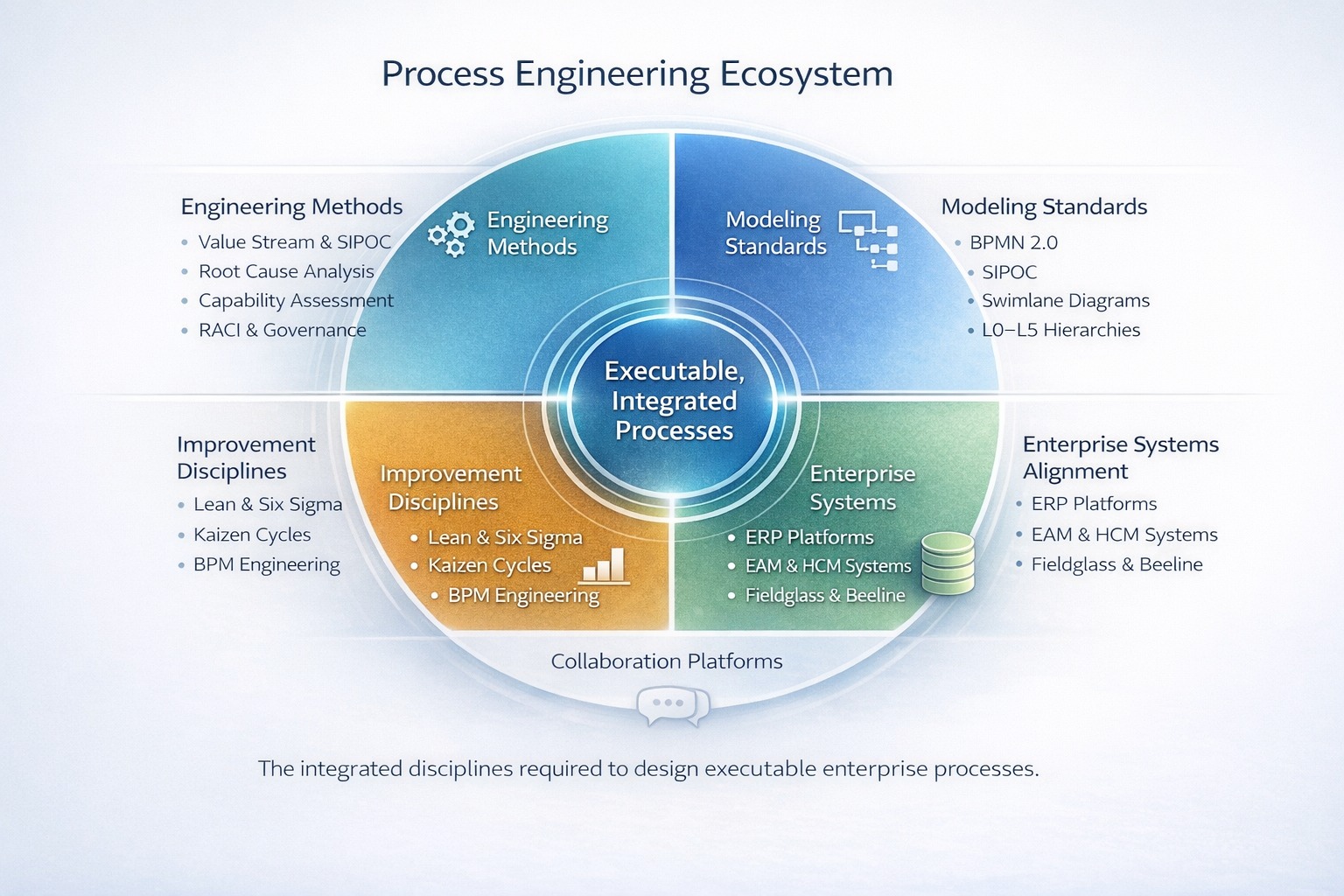
Process Engineering Ecosystem

Integrating methods, standards, improvement disciplines, and enterprise systems for executable, scalable processes.

Core Process Engineering Methods

Value stream modeling, root cause analysis, capability assessments, governance.

Embedded Continuous Improvement Disciplines

Lean, Six Sigma, Kaizen, BPM engineering applied for impact.

Standards-Based Process Modeling

BPMN 2.0, SIPOC, swimlane diagrams, hierarchical decomposition.

Platform-Native Process Development

Processes developed within existing collaboration ecosystems for rapid adoption.

Systems-Aware Process Architecture

Alignment with ERP, HCM, asset management, procurement platforms.

Professional Foundations

Synerquest methodologies are grounded in globally recognized disciplines spanning business analysis, performance management, process engineering, and organizational change.

  • CBAP (IIBA)PMPBalanced Scorecard Professional (BSP)
  • Lean Six SigmaPuMP Performance MeasurementProsci ADKAR

Ideal For

  • Cross-functional processes with unclear ownership and inconsistent execution
  • Organizations modernizing operational controls and performance visibility
  • Transformation initiatives where execution breaks across handoffs
  • Teams needing measurable, enforceable, and scalable process standards

Process excellence only works when it is engineered for execution — not documented for compliance.

Let's Engineer a Process That Actually Executes.

If your process work isn't changing performance, we'll diagnose why — then rebuild it from outcomes backwards.

Start the Conversation