What Is Change & Transformation Leadership
Change leadership ensures transformation translates into execution performance.
It focuses on embedding alignment, adoption, and accountability directly into delivery — ensuring how work gets done changes with the transformation.
Change leadership provides the structure required to:
- Align leadership direction
- Mobilize the organization
- Build execution readiness
- Sustain adoption over time
This is not a support function layered onto delivery — it is an execution capability that shapes whether transformation takes hold.
Why It Matters
Transformation fails when execution and adoption are not aligned — not when strategy is wrong.
Many transformation initiatives underperform because execution and adoption are treated as secondary considerations.
Common challenges include:
- Fragmented leadership alignment
- Change fatigue across initiatives
- Weak adoption of new operating models
- Disconnection between transformation intent and operational reality
Without structured change leadership, transformation outcomes remain inconsistent and difficult to sustain.
How Change Leadership Is Embedded in Execution
Change leadership is an embedded execution discipline, not a separate workstream.
Integration into delivery aligns with operating models and processes — execution capability evolves alongside program progress.
This approach emphasizes:
- Leadership alignment as a continuous discipline
- Execution readiness embedded within delivery
- Adoption linked directly to operational performance
- Transition-aware transformation design
The objective is durable execution capability, not just successful rollout.
The Execution Model for Change Leadership
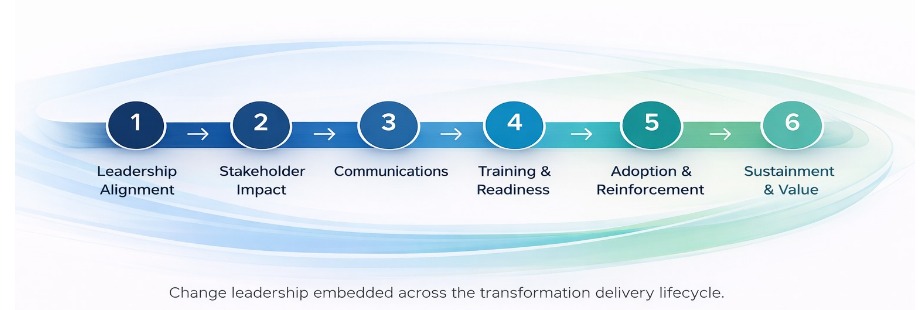
Change leadership is not delivered as a phase — it is executed as a system embedded across the transformation delivery lifecycle.
Synerquest delivers change leadership as an execution discipline embedded directly into transformation delivery. Rather than treating change as a downstream communications function, we integrate it across leadership alignment, stakeholder impact, communications, training, readiness, adoption, and sustainment.
Embedded Across the Delivery Lifecycle
Design ? Build ? Deploy ? Stabilize ? Optimize
This is how change leadership moves from intent to execution — and ensures transformation actually holds.
Leadership Alignment & Sponsorship
Establish executive alignment, sponsorship expectations, decision roles, and visible leadership engagement to reinforce change from the top.
Stakeholder & Impact Analysis
Assess who is impacted, how work is changing, where resistance may emerge, and what adoption risks must be addressed early.
Communication & Change Narrative
Build the case for change, align messages to stakeholder groups, and ensure communication supports action, not just awareness.
Training, Super Users & Readiness
Prepare impacted teams through targeted learning, role-based enablement, super user support, and business readiness activities.
Adoption, Reinforcement & Feedback
Track adoption signals, reinforce desired behaviors, gather feedback, and respond to issues before performance deteriorates.
Sustainment & Value Realization
Embed change into ongoing operations so new ways of working are sustained and transformation benefits are realized over time.
Change leadership only works when it is part of execution — not layered on top of it.
Proof
Execution in Practice
A real-world example of how execution-embedded change leadership restores alignment, adoption, and measurable outcomes.
A large-scale ERP transformation was experiencing fragmented leadership alignment, low adoption, and increasing execution risk.
Synerquest embedded change leadership directly into delivery — aligning stakeholders, activating adoption, and reinforcing execution discipline across workstreams.
-
?
Adoption stabilized within 90 days
-
?
Leadership alignment restored across business units
-
?
Execution risk reduced across critical workstreams
View Case Study
The Execution System Behind Change Leadership
Change leadership is not delivered as a separate workstream.
It is embedded directly into execution through the Synerquest Sundog™ system — aligning leadership, activating stakeholders, enabling capability, and reinforcing adoption over time.
This system is embedded directly into how we deliver change leadership.
What This Enables
Effective change leadership converts transformation intent into sustained execution performance across the enterprise.
- Stronger leadership alignment across transformation phases
- Faster adoption of new operating models, platforms, and ways of working
- Reduced execution risk across complex transformation programs
- Increased resilience through transition periods and competing priorities
- Sustained performance beyond initial deployment
- Stronger realization of transformation benefits through sustained adoption and behavioral follow-through
Where It Applies
This is most critical in environments where role clarity, stakeholder alignment, and adoption determine whether transformation succeeds.
Synerquest supports organizations undergoing high-impact transformation initiatives, including:
- Enterprise platform implementations (ERP, EAM, digital core)
- Operating model redesign
- Post-merger integration
- Large-scale modernization programs
- Multi-year transformation portfolios
In these environments, disciplined change leadership is essential for realizing expected value.
When to Engage
Organizations typically engage Synerquest when:
- Transformation outcomes must translate into sustained execution
- Leadership alignment requires structured reinforcement
- Adoption challenges are emerging across initiatives
- Execution risk is increasing during delivery
- Transformation requires an integrated change model
Early engagement helps embed change capability directly into transformation design and delivery.